
Bass Ukulele Tuner
Tuner settings


🎶 Tune by ear 🎶
If you're looking to tune your bass ukulele 🎶, you've come to the right place on the internet! Our bass ukulele tuner provided by OnlineTuner.org allows you to tune your bass ukulele effortlessly, straight from your web browser. Just click on the “Start tuner” button on the bass ukulele tuner below and pluck your strings one by one. Our tuner will guide you through the process and tell you whether your strings need to be tuned up or down. Additionally, you can hear all the notes corresponding to your bass ukulele strings - a bass ukulele tuning (EADG) - on our tuner synthesizer, so that you can tune your instrument by ear. More information on how to tune your bass ukulele with this online tuner and more ukulele tuning variations are available below. Enjoy your tuning experience!
How to use our bass ukulele tuner?
To accurately tune your bass ukulele using OnlineTuner.org's bass ukulele tuner, start by scrolling down to our bass ukulele tuner. Then, proceed with these steps:
- Ensure you're in a quiet environment to make sure you get the most precise tuning possible. Position yourself and your bass ukulele in front of the device you're using to access our bass ukulele tuner.
- Once you're on the tuner page, click the "Start Tuner" button and allow OnlineTuner.org to use your device's microphone.
- Activate the tuner and pluck each string of your bass ukulele individually, letting the note ring rather than damping it early. Watch the indications on the tuner; it will show the closest note to the one you're playing and indicate if the string needs to be tuned higher ("tune up") or lower ("tune down").
- Tune your bass ukulele's pegs while checking the online tuner's display until it confirms each string is perfectly in tune. Note that the note above the tuner meter will turn green when you've hit the right pitch.
Our bass ukulele tuner is equipped with precise technology and an easy-to-use interface to streamline your tuning.
How do I tune up/down a ukulele string?
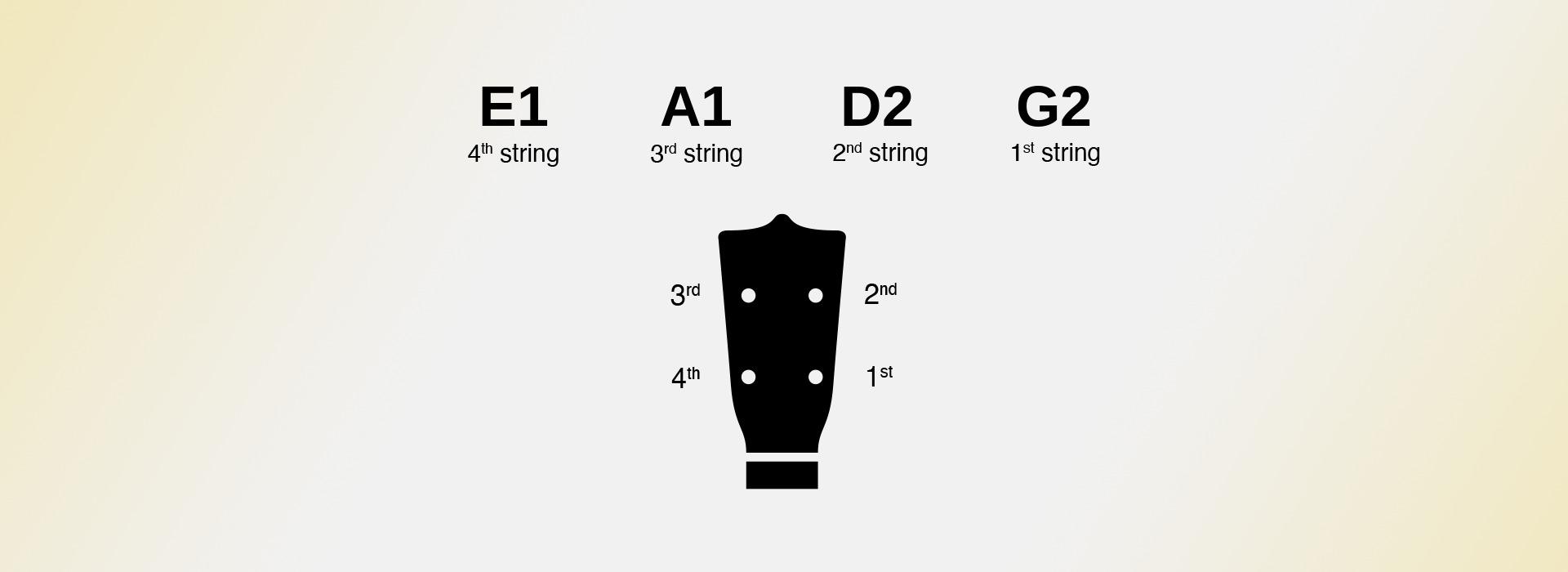
To tune a string of a bass ukulele, identify the corresponding tuning peg on your instrument. You may refer to our picture above. Pluck the string, then hold the peg and turn it to alter its pitch. If the tuner suggests tuning up for a higher pitch, turn the peg counter-clockwise. If it needs to be lower, turn it clockwise. Proceed carefully, adjusting in small increments and frequently checking the tuner to avoid over-tuning and potentially snapping the string. Bass ukulele strings are thick and stretch a great deal when new, so expect to come back and correct the tuning several times during the first few days. Always use a reliable tuner, like our bass ukulele tuner on OnlineTuner.org, to verify that you have reached the precise pitch before moving on to the next string.
What are the 4 strings of a bass ukulele tuning?
A bass ukulele has four strings, tuned to the same notes as a full-size bass guitar - E, A, D and G - despite the instrument's much shorter scale. That is why it sounds nothing like the standard ukulele tuning: it is a bass, in a ukulele-sized body. Unlike a standard ukulele, this tuning is not reentrant, so the strings rise steadily in pitch from the 4th to the 1st.
E1 - 4th string (lowest in pitch): This is the top string when you hold the bass ukulele and is tuned to E1, with a frequency of about 41.20 Hz.
A1 - 3rd string: This string is tuned to A1, with a frequency of about 55.00 Hz.
D2 - 2nd string: This string is tuned to D2, with a frequency of about 73.42 Hz.
G2 - 1st string: This is the bottom string when you hold the bass ukulele and is tuned to G2, with a frequency of about 98.00 Hz.
Because these notes sit so low, bass ukuleles are usually strung with thick polyurethane or silicone-coated strings that need to be under high tension to reach pitch on a short scale. Give a new set several days to settle before judging its intonation.
Understand our bass ukulele tuner's settings
The present bass ukulele tuner, provided to you by OnlineTuner.org, is designed to suit novice as well as experimented musician's needs. It offers an accurate, robust and versatile tuning experience that can be customized to a user's specific requirements. You can access each of these settings directly on our bass ukulele tuner, or by clicking on “Advanced settings”.
Adjust the A4 frequency of our bass ukulele tuner
One of the most crucial settings to consider when using our bass ukulele tuner is the adjustable frequency of the A4 note. This setting serves as the foundational pitch from which all other notes are calculated. While the default is often set to the international standard of A=440 Hz, many musicians have strong preferences for alternative frequencies such as A=432 Hz or A=442 Hz. The ability to adjust this foundational pitch makes our bass ukulele tuner flexible enough to accommodate musicians who play in various tuning systems, whether they be historical temperaments - a lower A4 frequency was more popular in the past - or modern experimental tunings.
Set the sensitivity of our bass ukulele tuner
Another important feature of our bass ukulele tuner is the sensitivity settings, which can be altered to suit the specific environment or instrument in use. You can play with the detection algorithm's probability threshold. This matters more on a bass ukulele than on any other ukulele: at 41 Hz, the fundamental of the low E string is quieter than its overtones through most laptop and phone microphones, and a tuner set too loosely may lock onto the octave above. If your low string reads as E2 rather than E1, raise the threshold and pluck closer to the bridge.
Using our bass ukulele tuner in challenging environments
Further, the noise gate setting of our bass ukulele tuner stands as a strong ally for those tuning in acoustically challenging environments. Whether you're in a room with an air conditioner humming in the background or in a rehearsal space with other musicians, the noise gate allows you to set a volume threshold below which sounds will be ignored by our bass ukulele tuner. Low-frequency background noise - traffic, ventilation, footsteps overhead - sits in the same range as your lowest strings, so a slightly higher gate is often worth setting before you begin.
Meter tuner vs Slider tuner
This last setting is just a matter of taste, but you can choose whether you prefer to use our Meter tuner or rather our Slider tuner. To alternate between one and the other, just click on the "Display the slider tuner" switch of our bass ukulele tuner.

All our online ukulele tuners
Different songs call for different tunings. Below you will find every free online tuner we offer for this instrument, from standard tuning to alternative options such as drop, open and half-step tunings. Each tuner runs directly in your browser and listens through your microphone. There is nothing to install and nothing to pay. Choose the tuning you need and start playing in seconds.


