
All Fourths Guitar Tuner
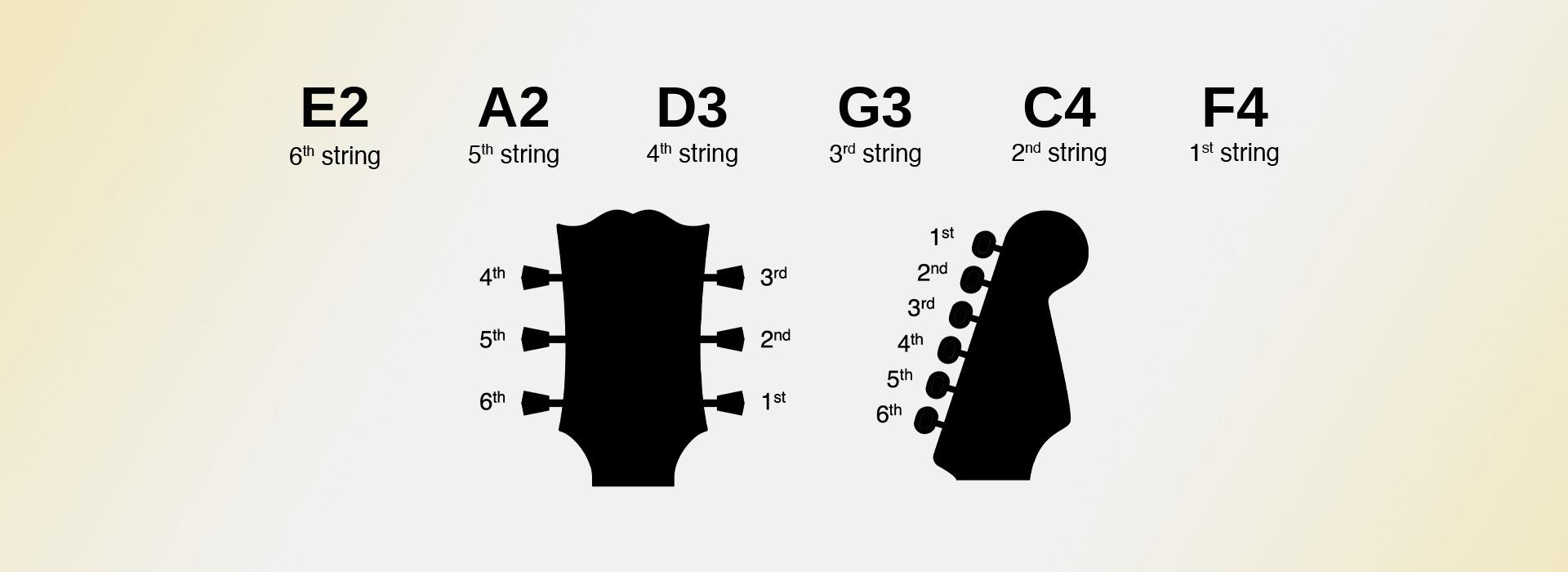
Tuner settings


🎶 Tune by ear 🎶
All Fourths tuning is E, A, D, G, C, F — the standard tuning with the top two strings raised so that every pair of adjacent strings is a perfect fourth apart. Standard tuning breaks that pattern once, with a major third between the 3rd and 2nd strings, and All Fourths simply removes the exception.
The consequence is that any scale, arpeggio or interval shape is identical on every set of strings and can be moved anywhere on the neck without adjustment. Click here to open the tuner and follow the steps below.
Strings and Frequencies of the Guitar in All Fourths Tuning
In All Fourths tuning, the guitar strings are tuned to the following notes and frequencies:
- 6th string (E2): 82.41 Hz
- 5th string (A2): 110.00 Hz
- 4th string (D3): 146.83 Hz
- 3rd string (G3): 196.00 Hz
- 2nd string (C4): 261.63 Hz
- 1st string (F4): 349.23 Hz
Only the top two strings change: the 2nd goes from B3 up to C4 and the 1st from E4 up to F4, each a single semitone. A standard set handles this without complaint, though some players fit a slightly lighter 1st string to even out the feel. This is one of the least demanding alternate tunings to set up.
Tune your Guitar to All Fourths
Tuning your guitar to All Fourths with OnlineTuner.org is straightforward:
- Ensure you are in a quiet environment and position your guitar near your device’s microphone.
- Click the "Start Tuner" button and allow microphone access when prompted.
- Pluck each string of your guitar one by one, letting the note ring rather than damping it, and the tuner will display the nearest note.
- Use the tuning pegs to adjust each string until it matches the correct note for All Fourths.
- Retune and double-check each string, since adjusting one string changes the tension on the others.
Both strings that move go up rather than down, so approach the target pitch from below and stop as soon as the tuner reads in tune — overshooting a plain 1st string by much is how it breaks.
OnlineTuner.org's Features for Tuning your Guitar More Accurately
OnlineTuner.org offers a number of features that make tuning to All Fourths both easy and precise:
- Customizable A4 Frequency: Adjust the reference pitch for A4 from the default 440 Hz to alternatives like 432 Hz or 442 Hz, depending on your preferences.
- Sensitivity Control: Fine-tune the tuner's sensitivity so it picks up only the sound of your guitar, even in noisy environments.
- Noise Gate: Set a volume threshold to filter out background noise and improve accuracy.
- Save Settings: Keep your preferred sensitivity and reference pitch for future tuning sessions.
- Visual Tuning Interface: Choose between a meter or a slider display, depending on your personal preference.
History of All Fourths Tuning for the Guitar
All Fourths has been a working jazz and fusion tuning since at least the 1970s, when players who thought in terms of intervals rather than chord grips began questioning why the guitar had one irregular string pair at all. Allan Holdsworth is the name most associated with it, and Stanley Jordan built his two-handed tapping technique on the regularity it provides.
The idea is older than the guitar, though. Bass guitars have always been tuned in straight fourths, and All Fourths essentially asks why the guitar stopped. The answer is historical rather than musical: the major third makes open chords and barre shapes fall under the hand, and those were what the instrument was built around.
Usage of All Fourths Tuning
All Fourths is used mainly by jazz, fusion and instrumental players who improvise across the whole neck. Learn a shape once and it works on every string pair, which cuts the amount of memorisation the guitar normally demands roughly in half and makes wide-interval lines far easier to visualise.
The trade-off is real: open chords, standard barre shapes and most chord charts no longer apply, so it suits single-note playing far better than accompaniment. If you want a tuning that changes the sound without discarding what you already know, our Drop D tuner or DADGAD tuner are gentler places to start.
Understand our All Fourths guitar tuner's settings
The present All Fourths guitar tuner, provided to you by OnlineTuner.org, is designed to suit both novice and experienced musicians' needs. It offers an accurate, robust and versatile tuning experience that can be customized to your specific requirements. You can access each of these settings directly on our All Fourths guitar tuner, or by clicking on “Advanced settings”.
Set the A4 value of our All Fourths guitar tuner
One of the most crucial settings to consider when using our All Fourths guitar tuner is the adjustable frequency of the A4 note. This setting serves as the foundational pitch from which all other notes are calculated. While the default is set to the international standard of A=440 Hz, many musicians have strong preferences for alternative frequencies such as A=432 Hz or A=442 Hz. The ability to adjust this foundational pitch makes our All Fourths guitar tuner flexible enough to accommodate musicians who play in various tuning systems, whether historical temperaments or modern experimental tunings.
Set the sensitivity of our All Fourths guitar tuner
Another pivotal feature is the sensitivity setting, which can be altered to suit the specific environment or instrument in use. You control it through the detection algorithm's probability threshold, which determines how readily the tuner commits to a note. All Fourths only moves the top two strings by a semitone each, so the tuner has to distinguish B3 from C4 and E4 from F4 — pairs a semitone apart. A stricter threshold makes it commit rather than hover between the two, which is exactly what you want when the whole change is that small.
Using our All Fourths guitar tuner in challenging environments
Further, the noise gate setting of our All Fourths guitar tuner stands as a strong ally for those tuning in acoustically challenging environments. Whether you are in a room with an air conditioner humming in the background or in a rehearsal space with other musicians, the noise gate lets you set a threshold below which sounds are ignored. This ensures that only the sound of your instrument is picked up and analyzed, increasing the tuner’s accuracy.
Meter tuner vs Slider tuner
This last setting is simply a matter of taste, but you can choose whether you prefer our Meter tuner or our Slider tuner. To alternate between one and the other, just click the "Display the slider tuner" switch on our All Fourths guitar tuner.

All our online guitar tuners
Different songs call for different tunings. Below you will find every free online tuner we offer for this instrument, from standard tuning to alternative options such as drop, open and half-step tunings. Each tuner runs directly in your browser and listens through your microphone. There is nothing to install and nothing to pay. Choose the tuning you need and start playing in seconds.


