
Drop B Guitar Tuner
Tuner settings


🎶 Tune by ear 🎶
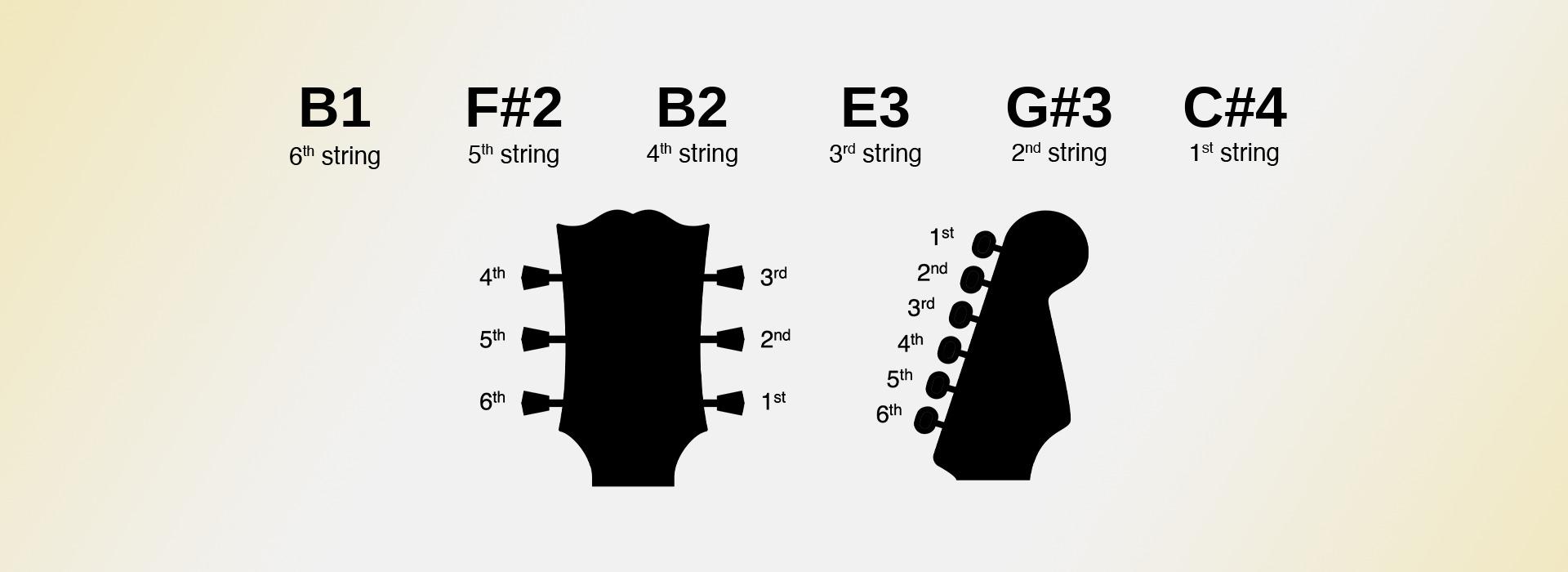
Drop B is Drop C lowered by one more semitone: B, F#, B, E, G#, C#. It keeps the same interval pattern — a fifth between the 6th and 5th strings, fourths above that — so every shape you use in Drop D or Drop C transfers unchanged. Only the pitch moves.
That extra semitone matters more than it sounds like it should. At B1 the 6th string is close to the bottom of what a normal 25.5" guitar can hold cleanly, so Drop B is where string gauge and setup stop being optional. Click here to open the tuner and work through the steps below.
Strings and Frequencies of the Guitar in Drop B Tuning
In Drop B tuning, the guitar strings are tuned to the following notes and frequencies:
- 6th string (B1): 61.74 Hz
- 5th string (F#2): 92.50 Hz
- 4th string (B2): 123.47 Hz
- 3rd string (E3): 164.81 Hz
- 2nd string (G#3): 207.65 Hz
- 1st string (C#4): 277.18 Hz
B1 sits at 61.74 Hz, roughly a fourth below where a standard 6th string is designed to work. Most players use at least a 12-60 set, and many move to a 13-62 or a baritone-scale instrument. Too light a string here will not just sound flabby — it will read as unstable on any tuner, including this one, because the fundamental is weak and the harmonics dominate.
Tune your Guitar to Drop B
Tuning your guitar to Drop B with OnlineTuner.org is straightforward:
- Ensure you are in a quiet environment and position your guitar near your device’s microphone.
- Click the "Start Tuner" button and allow microphone access when prompted.
- Pluck each string of your guitar one by one, letting the note ring rather than damping it, and the tuner will display the nearest note.
- Use the tuning pegs to adjust each string until it matches the correct note for Drop B.
- Retune and double-check each string, since adjusting one string changes the tension on the others.
Tune the 6th string in two passes. Take it down to roughly B, tune the other five, then come back to it — the neck relief shifts as five strings lose tension, and the low B will have drifted.
OnlineTuner.org's Features for Tuning your Guitar More Accurately
OnlineTuner.org offers a number of features that make tuning to Drop B both easy and precise:
- Customizable A4 Frequency: Adjust the reference pitch for A4 from the default 440 Hz to alternatives like 432 Hz or 442 Hz, depending on your preferences.
- Sensitivity Control: Fine-tune the tuner's sensitivity so it picks up only the sound of your guitar, even in noisy environments.
- Noise Gate: Set a volume threshold to filter out background noise and improve accuracy.
- Save Settings: Keep your preferred sensitivity and reference pitch for future tuning sessions.
- Visual Tuning Interface: Choose between a meter or a slider display, depending on your personal preference.
History of Drop B Tuning for the Guitar
Drop B arrived as the metalcore and deathcore scenes of the mid-2000s pushed past Drop C looking for more weight. It was a natural next step rather than an invention: the same shapes, one fret lower, with the low string finally deep enough to sit under a double-kick pattern without competing with the bass guitar.
Its adoption tracked the spread of heavier factory string sets and better-built extended-range guitars. Once 12-60 sets were on every shop wall and 26.5" baritones stopped being custom orders, tuning a six-string to B became a practical choice for touring bands rather than a studio-only trick.
Usage of Drop B Tuning
Drop B is used across metalcore, deathcore and djent-adjacent styles by bands including Parkway Drive, A Day to Remember and Bring Me the Horizon. It gives a six-string much of the low-end reach of a seven-string while keeping a six-string neck, which is the main reason players choose it over adding a string.
Outside heavy music it is also a practical tuning for accompanying low voices, since it puts the guitar a fourth below standard while leaving fingerings alone. If Drop B turns out to be lower than you need, our Drop C tuner is the next step up.
Understand our Drop B guitar tuner's settings
The present Drop B guitar tuner, provided to you by OnlineTuner.org, is designed to suit both novice and experienced musicians' needs. It offers an accurate, robust and versatile tuning experience that can be customized to your specific requirements. You can access each of these settings directly on our Drop B guitar tuner, or by clicking on “Advanced settings”.
Set the A4 value of our Drop B guitar tuner
One of the most crucial settings to consider when using our Drop B guitar tuner is the adjustable frequency of the A4 note. This setting serves as the foundational pitch from which all other notes are calculated. While the default is set to the international standard of A=440 Hz, many musicians have strong preferences for alternative frequencies such as A=432 Hz or A=442 Hz. The ability to adjust this foundational pitch makes our Drop B guitar tuner flexible enough to accommodate musicians who play in various tuning systems, whether historical temperaments or modern experimental tunings.
Set the sensitivity of our Drop B guitar tuner
Another pivotal feature is the sensitivity setting, which can be altered to suit the specific environment or instrument in use. You control it through the detection algorithm's probability threshold, which determines how readily the tuner commits to a note. This setting earns its keep in Drop B. At 61.74 Hz the low B produces more energy in its harmonics than in its fundamental on most laptop and phone microphones, and a permissive threshold will happily report B2 instead. Raise it, and pick nearer the bridge for a cleaner reading.
Using our Drop B guitar tuner in challenging environments
Further, the noise gate setting of our Drop B guitar tuner stands as a strong ally for those tuning in acoustically challenging environments. Whether you are in a room with an air conditioner humming in the background or in a rehearsal space with other musicians, the noise gate lets you set a threshold below which sounds are ignored. This ensures that only the sound of your instrument is picked up and analyzed, increasing the tuner’s accuracy.
Meter tuner vs Slider tuner
This last setting is simply a matter of taste, but you can choose whether you prefer our Meter tuner or our Slider tuner. To alternate between one and the other, just click the "Display the slider tuner" switch on our Drop B guitar tuner.

All our online guitar tuners
Different songs call for different tunings. Below you will find every free online tuner we offer for this instrument, from standard tuning to alternative options such as drop, open and half-step tunings. Each tuner runs directly in your browser and listens through your microphone. There is nothing to install and nothing to pay. Choose the tuning you need and start playing in seconds.


