
Drop A Guitar Tuner
Tuner settings


🎶 Tune by ear 🎶
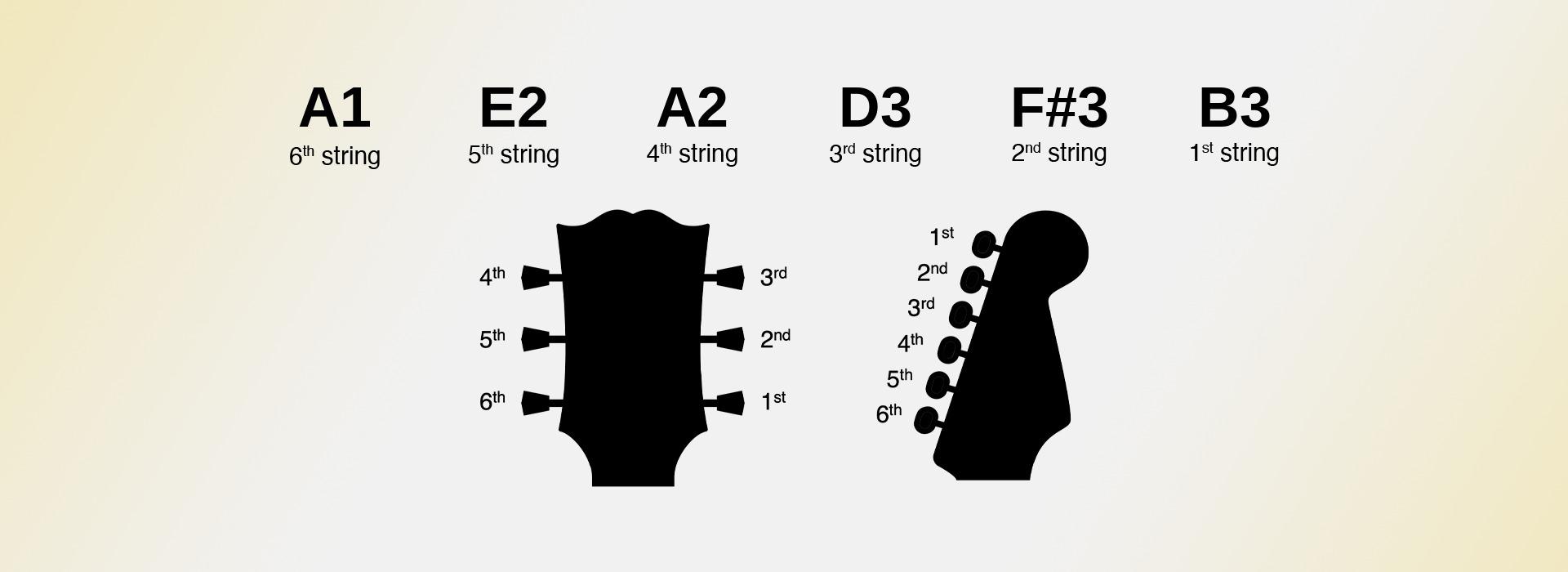
Drop A is the lowest of the common drop tunings for a six-string guitar: A, E, A, D, F#, B. It is B standard with the 6th string dropped a whole tone to A, which puts the bottom string at 55.00 Hz — the same A as the open 5th string of a bass guitar.
The interval layout is unchanged from Drop C and Drop B, so the shapes carry over. What changes is the physics: at this pitch, scale length, string gauge and pickup height all start to matter. Click here to open the tuner and use the steps below.
Strings and Frequencies of the Guitar in Drop A Tuning
In Drop A tuning, the guitar strings are tuned to the following notes and frequencies:
- 6th string (A1): 55.00 Hz
- 5th string (E2): 82.41 Hz
- 4th string (A2): 110.00 Hz
- 3rd string (D3): 146.83 Hz
- 2nd string (F#3): 185.00 Hz
- 1st string (B3): 246.94 Hz
Drop A on a standard 25.5" scale needs a heavy set — 13-65 or thicker — and even then the 6th string will be slack. A baritone scale of 26.5" to 28" is the more common solution, and many players use a seven-string instead and simply ignore the top string. Whatever you play, expect to adjust intonation and truss rod after switching.
Tune your Guitar to Drop A
Tuning your guitar to Drop A with OnlineTuner.org is straightforward:
- Ensure you are in a quiet environment and position your guitar near your device’s microphone.
- Click the "Start Tuner" button and allow microphone access when prompted.
- Pluck each string of your guitar one by one, letting the note ring rather than damping it, and the tuner will display the nearest note.
- Use the tuning pegs to adjust each string until it matches the correct note for Drop A.
- Retune and double-check each string, since adjusting one string changes the tension on the others.
Give the low A time. A string being taken this far down keeps creeping for several minutes after it first reads in tune, so tune it, play the other five, then check it again before you record anything.
OnlineTuner.org's Features for Tuning your Guitar More Accurately
OnlineTuner.org offers a number of features that make tuning to Drop A both easy and precise:
- Customizable A4 Frequency: Adjust the reference pitch for A4 from the default 440 Hz to alternatives like 432 Hz or 442 Hz, depending on your preferences.
- Sensitivity Control: Fine-tune the tuner's sensitivity so it picks up only the sound of your guitar, even in noisy environments.
- Noise Gate: Set a volume threshold to filter out background noise and improve accuracy.
- Save Settings: Keep your preferred sensitivity and reference pitch for future tuning sessions.
- Visual Tuning Interface: Choose between a meter or a slider display, depending on your personal preference.
History of Drop A Tuning for the Guitar
Drop A came out of the same downward drift as Drop B, but it needed the instruments to catch up first. Through the late 2000s, as baritone and seven-string guitars became affordable, bands that had been tuning six-strings to their limit could finally get to A with strings that stayed taut. Slipknot's All Hope Is Gone is one of the better-known records to use it.
It also marks the point where guitar tunings started to overlap with bass range. At A1 the guitar is sitting on notes the bass guitar already owns, which forced a change in how bands arrange parts — a change that shaped the production style of a lot of late-2000s and 2010s heavy music.
Usage of Drop A Tuning
Drop A belongs to deathcore, djent and the heavier end of modern metal, used by bands such as Whitechapel, Chelsea Grin and Machine Head. The single-finger power chord across the bottom three strings is the whole point: it lets a riff move quickly through a register that would otherwise need awkward fingerings.
Because the guitar now occupies bass territory, arrangements usually thin out the low end elsewhere — bassists move up, and rhythm guitars are often high-pass filtered. If A is further than your instrument can comfortably go, our Drop B tuner gets most of the weight with far less strain.
Understand our Drop A guitar tuner's settings
The present Drop A guitar tuner, provided to you by OnlineTuner.org, is designed to suit both novice and experienced musicians' needs. It offers an accurate, robust and versatile tuning experience that can be customized to your specific requirements. You can access each of these settings directly on our Drop A guitar tuner, or by clicking on “Advanced settings”.
Set the A4 value of our Drop A guitar tuner
One of the most crucial settings to consider when using our Drop A guitar tuner is the adjustable frequency of the A4 note. This setting serves as the foundational pitch from which all other notes are calculated. While the default is set to the international standard of A=440 Hz, many musicians have strong preferences for alternative frequencies such as A=432 Hz or A=442 Hz. The ability to adjust this foundational pitch makes our Drop A guitar tuner flexible enough to accommodate musicians who play in various tuning systems, whether historical temperaments or modern experimental tunings.
Set the sensitivity of our Drop A guitar tuner
Another pivotal feature is the sensitivity setting, which can be altered to suit the specific environment or instrument in use. You control it through the detection algorithm's probability threshold, which determines how readily the tuner commits to a note. Drop A is the hardest case on this site for pitch detection: A1 sits at 55.00 Hz, below what many built-in microphones reproduce well. Raise the threshold, pick firmly near the bridge, and if the tuner still jumps an octave, try moving the guitar closer to the microphone rather than playing harder.
Using our Drop A guitar tuner in challenging environments
Further, the noise gate setting of our Drop A guitar tuner stands as a strong ally for those tuning in acoustically challenging environments. Whether you are in a room with an air conditioner humming in the background or in a rehearsal space with other musicians, the noise gate lets you set a threshold below which sounds are ignored. This ensures that only the sound of your instrument is picked up and analyzed, increasing the tuner’s accuracy.
Meter tuner vs Slider tuner
This last setting is simply a matter of taste, but you can choose whether you prefer our Meter tuner or our Slider tuner. To alternate between one and the other, just click the "Display the slider tuner" switch on our Drop A guitar tuner.

All our online guitar tuners
Different songs call for different tunings. Below you will find every free online tuner we offer for this instrument, from standard tuning to alternative options such as drop, open and half-step tunings. Each tuner runs directly in your browser and listens through your microphone. There is nothing to install and nothing to pay. Choose the tuning you need and start playing in seconds.


